D. plantarius populations in the UK
Homepage
What's new?
Biology
Distribution
Identification
Conservation
Genetic Study
Literature
Links
How you can help
Picture Gallery
Contact Us
| Redgrave and Lopham Fen | Pevensey Levels | South Wales | UK conservation status |
Discovery of the UK populationsDolomedes plantarius was not discovered in the UK until 1956 when eminent arachnologist Eric Duffey found it around the margins of peat pools at Redgrave and Lopham Fen, at the source of the River Waveney on the Norfolk/Suffolk border (Duffey 1958). A second UK population was discovered, 180 km away, when Peter Kirby identified D. plantarius from grazing marsh ditches on the Pevensey Levels in East Sussex in 1988 (Kirby 1990). This population had been known to biologists for several years but it was assumed to be D. fimbriatus. It had been known to local people for much longer and, in the 1950s, was reported to be common in the areas in which it is most still abundant.In 2003, a third UK population was discovered on a disused canal near Swansea, South Wales, by local naturalist Mike Clark. Immature Dolomedes found on near-by Crymlyn Bog were subsequently also identified as D. plantarius. Although Dolomedes fimbriatus was reported from this site by Andrew Lees in 1978, the record was never verified. The lack of any reliable historical record for this species in Britain makes it impossible either to assess the extent of its decline or to account for its present highly disjunct distribution. Its extreme rarity must result from the loss and degradation of wetlands in general, and of both lowland fens, and ditch systems in lowland grazing marsh, in particular. Back to top of page The Redgrave and Lopham Fen populationHistoryFour years after the discovery of D. plantarius, an artesian borehole was sunk close to the edge of the Fen. Removal of 3,500 tonnes of water a day from the underlying chalk over the following four decades, exacerbated by droughts in the 1970s, '80s and '90s, progressively dried out and degraded the fen. A hydrological regime controlled by rainfall patterns and inflow of eutrophic water from a catchment dominated by intensive pig farming, replaced the fen's formerly copious supply of base-rich, nutrient-poor artesian groundwater. This rose from marginal springs and seepage lines. Internationally rare plant assemblages were degraded or lost, together with many rare species of plants and invertebrates (Redgrave and Lopham Fen History).HabitatRaft spiders are restricted to areas of the fen dominated by Cladium mariscus (Great Fen Sedge). They occur around the margins of pools that were created both by traditional peat digging for peat for domestic fuel and, more recently, by mechanical excavation to increase the availability of water to the spiders in dry summers (Duffey 1977, Smith 2000).D. plantarius is one of few of the fen's national rarities to survive this period. The depth of the fen's peat pools, enabling them to hold water even in dry summers, must have been a major factor in the survival of the spiders as the fen began to dry out. ConservationDespite the excavation of additional, deep pools to provide standing water for the spiders in the 1970s and 1980s, the droughts of the late 1980s left very little standing water on the fen and D. plantarius became confined to two, small, isolated areas, representing a reduction of over of over 80% in its likely former range (Smith 2000).In 1991 a Species Recovery Programme project was initiated by English Nature with the aim of preventing extinction of the residual population: significant expansion was not a realistic objective while the fen remained dry. Systematic monitoring and positive habitat management measures were established. The latter included re-instating cutting of C. mariscus on a traditional rotation, scrub removal, excavation of additional pools and deepening of existing ones and, most radically, the introduction of an irrigation supply, piped from the borehole to the core of the spider population (Smith 2000). Population TrendsThe borehole closed in July 1999, at the end of a 5-year EU-funded programme to restore the fen by a combination of extensive removal of scrub, stripping of oxidized surface peat and grazing. A run of wet seasons resulted in rapid hydrological recovery of the Fen. Despite this, and despite the very high potential fecundity of the spiders (Biology), neither of the residual populations have shown any evidence of recovery in population size. Population trends over the seventeen years of systematic monitoring under the Species Programme show that there is significant variation between years and between two residual populations, but no evidence of any long-term trend or of recovery: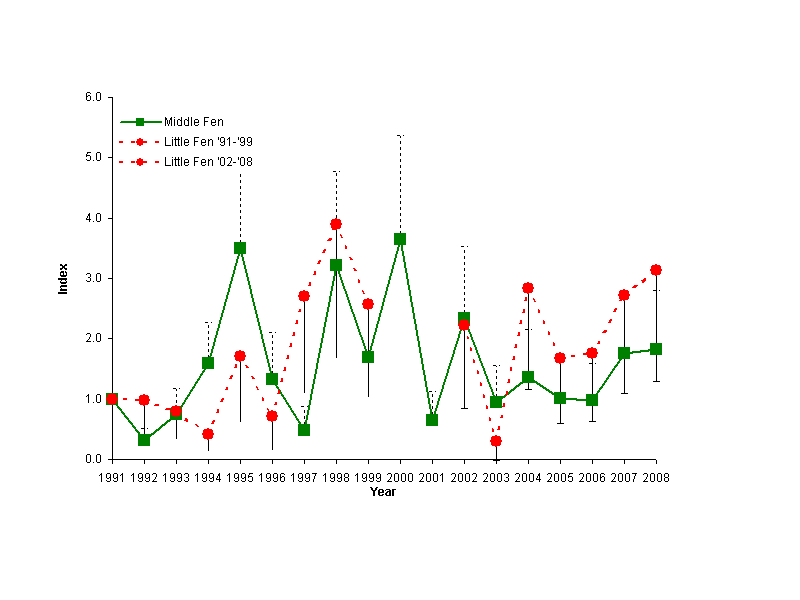 Annual population indices for the two residual sub-populations of D. plantariuson Redgrave and Lopham Fen NNR, in July 1991-2008. Data generated by a log-linear Poisson regression model plotted on a linear scale. 2SEs shown as positive bars for the sub-population on Middle Fen and negative bars for that on Little Fen.
Since 2006, despite the lack of increase in the population index, the range of one of the two sub-populations at Redgrave and Lopham Fen started to increase, with spiders being recorded up to 130m further west along a chain of turf ponds leading away from the core area on Middle Fen by 2008. The spiders have now reached a series of ponds on which they were last recorded in 1985. This spread is thought to result from a combination of substantially improved vegetation management in the area, together with a long series of summers in which the pools have not dried out The FutureMany factors may have contributed to the failure of the Redgave and Lopham Fen spider population to start to recover since 1999. These include:
Although it is hoped that the recent expansion in the range of the sub-population on Middle Fen will continue, this advance is likely to be limited by the availability of deep turf ponds. Areas adjacent to ponds into which the population is expanding have vegetation that is increasingly appropriate for the spiders but have no deep ponds. Extending the series of ponds is likely to be the only effective means of perpetuating this slow advance in range. Elsewhere on the fen, another cause for optimism about the future of the D. plantarius population is the colonisation by Cladium mariscus of the fringes of many of the large water bodies created as part of the restoration operation. Eight years after creation of these scrapes, C. mariscus is becoming increasingly dominant. At the same time much of the Phragmites australis, the initial dominant, is becoming less vigorous. If continued, this progression will result in a substantial increase in the area of the fen that could potentially support D. plantarius. To download summary reports on the status of Dolomedes plantarius at Redgrave and Lopham Fen in 2006 click here  (764 KB) and in 2007 click here
(754 KB).
Earlier reports on the status of D. plantarius at Redgrave and Lopham Fen NNR are published as English Nature Research Reports and can be obtained from Natural England (Northminster House, Peterborough PE1 1UA, UK)
(764 KB) and in 2007 click here
(754 KB).
Earlier reports on the status of D. plantarius at Redgrave and Lopham Fen NNR are published as English Nature Research Reports and can be obtained from Natural England (Northminster House, Peterborough PE1 1UA, UK)
Back to top of page The Pevensey Levels populationHabitatThe Pevensey Levels comprise one of the largest continuous lowland wet grazing systems in south-east England. Although over 500ha have been converted to arable, 3500ha of low-lying grazing meadow remain, intersected by a complex network of ditches. The aquatic communities supported by the ditches include 68% of British aquatic plant species and many nationally rare invertebrates. The national and international importance of the area is reflected in its designation as an SSSI and RAMSAR site. Some of the best habitat (181.6 ha) is protected as a National Nature Reserve (NNR), 130.2 ha of which is managed by the Sussex Wildlife Trust (SWT).Although the Pevensey habitat is very different from that at Redgrave and Lopham Fen they share characteristics common to western European D. plantarius sites. Both are lowland wetlands fed by neutral to alkaline, base-rich water: the structure of the vegetation is more important than its species composition (Smith 2000). The requirement for stiff-leaved, emergent vegetation to support the nursery webs (Biology), which is met primarily by Cladium mariscus at Redgrave and Lopham Fen, is met by a range of emergent marginal species, such as Carex pseudocyperus, as well as by the stiff leaves of the floating rosettes of Stratiotes aloides on the Pevensey Levels. ConservationFollowing the discovery of D. plantarius in 1988, English Nature commissioned a large-scale survey of its range and abundance in 1990 (Jones 1992). This survey, of ca 90km of ditches throughout the SSSI and in adjacent areas, revealed a very extensive population. In the areas of best habitat, primarily on gravity-drained marshes, densities were often very high: nursery web densities averaged one per 2m of bank. Away from this core area, however, the pump-drained marshes supported a much lower population density and the population appeared to be very fragmented. On the basis of nursery web counts, the total adult female population was estimated to be in the order of 3000 at a time when the Redgrave and Lopham Fen population was thought to have, at best, only tens of adult females.Although the Pevensey population was much larger than that at Redgrave and Lopham Fen in 1990, it is widely considered that habitat quality on the Levels has declined during the last fifty years. Drainage schemes, implemented in the 1960s and 1970s substantially reduced water levels and allowed further conversion of pasture to arable. Water quality has also declined and some of the main channels have become eutrophic. A further threat to the rich species assemblages of the ditches has come from dramatic increases in the populations of alien water plants, including Azolla filiculoides, Crassula helmsii and, most recently, Hydrocotyle ranunculoides. Since the early 1990s, efforts by the Environment Agency, Natural England, the Sussex Wildlife Trust and local landowners, have resulted in measures to address these problems. These have resulted in major changes in water level and land management on the Levels. A Wildlife Enhancement Scheme (WES) on the SSSI has provided landowners with tiered financial incentives for environmentally sensitive practices, including water level and ditch management, reduced stocking rates and restrictions on agrochemical use. More recently, the introduction of the Entry Level (ELS) and Organic Entry Level (OELS) Stewardship Schemes has provided further opportuities for lanowners throughout the area to receive financial incentives for management practices that benefit wetland wildlife. Improved water level management has been made possible largely by the modification of existing sluices and construction new ones, together with better management of abstraction for public water supply. The FutureTo assess the response of D. plantarius to the changes in management on the Pevensey Levels, and to monitor changes in the extent and status of the population, Natural England are developing a long-term population monitoring programme for the area.In the medium term, sea level rise must be seen as a potenital threat to the Pevensey population, the greater part of which is on the lowest-lying Levels that were reclaimed from salt marsh in the Middle Ages. Back to top of page The South Wales PopulationIn May 2003 D. plantarius was discovered along a short section of the bank of the disused Tennant Canal where it flows through Pant-y-Sais NNR, east of Swansea. In common with the English sites, this a lowland waterbody fed by neutral to alkaline, base-rich water. Open, stiff-leaved tussocks of Carex paniculata (tussock sedge) provide the main structure for nursery-web construction although webs are also found in Glyceria maxima. Survey work suggests that the spiders are much less abundant in what appears to be very suitable fen vegetation in the immediately adjacent Pant-y-Sais Reserve. They appear to breed there in some years but not in others, probably limited by the small number of turf ponds that hold water in dry years. D. plantarius also occurs ca 2.5km further west along the course of the Tennant Canal, where it runs in Crymlyn Bog NNR. The full extent of the population at this site is not yet known because the terrain makes survey work very difficult.Back to top of page The future for D. plantarius conservation in the UKD. plantarius is intrinsically very vulnerable to extinction because it is restricted to only three sites, at one of which its popoulation is extremely small. Its Species Action Plan, first produced in 1999, seeks to address this issue with the following ambitious targets for its future status:
During 2008 and 2009, as part of the evaluation process, survey work is underway to check that our current understanding of the UK distribution of D. plantarius is correct and that populations have not been overlooked or misidentified. Potentially suitable wetland sites are being surveyed for D. plantarius and sites where D. fimbriatus has been recorded, particularly those with atypical habitat for this species, are being checked to ensure that the species has been correctly identified. At the end of 2009 the evaluation process will be reviewed and a final decision will be made on whether to go ahead with the translocation programme in 2010. In preparation for this possibility, techniques for rearing newly-hatched D. plantarius in captivity are being tested at the John Innes Centre Insectory, Norwich, during 2008/09. If the translocation goes ahead, it is likely to use immature spiders, reared from egg sacs brought in from the wild to achieve very high survival rates. The mothers of these broods will be returned to the wild where they are likely to produce a second brood. If very high survival rates can be achieved, a proportion of the captive immatures will be returned to supplement their natal populations whilst the remainder will be used to establish new populations. Research currently in progress will be used to decide whether to use spiders of single or mixed provenance at the new sites. Back to top of page UK Conservation StatusAs a result of its extreme vulnerability in the UK, D. plantarius is classified as Endangered (Merrett and Bratton, 1991), is fully protected under Schedule 5 of the Wildlife and Countryside Act 1981 and is the subject of a Species Action Plan (UK Biodiversity Steering Group, 1999). Click here to view the Action Plan and here to view the revisions that followed the 2005 BAP review.PLEASE NOTE that a licence is required under the Wildlife and Countryside Act 1981 for any activity that is likely to cause disturbance to this species. For information on licencing click here. Back to top of page |
|||
 HOMEPAGE
This site is maintained by Helen Smith |
|||